





Peptides UK 2026: Mechanisms, Pathways & Laboratory Research Hub
Peptide Research UK 2026
The UK peptide research landscape in 2026 has shifted toward precision receptor signalling, pathway-specific biological modulation and controlled in-vitro analysis.
Rather than broad-spectrum pharmacological intervention, laboratories increasingly investigate short-chain amino acid sequences that interact with highly selective molecular targets and defined intracellular cascades.
This hub is structured by biological pathway — not by product category. Compounds are referenced where relevant to the mechanism.
For structured compound profiles:
https://6pack-supplements.co.uk/peptides-uk/
For full laboratory catalogue access:
https://6pack-supplements.co.uk/product-category/peptides-uk/
Why Peptides Dominate Modern Signalling Research
Peptides offer several advantages in experimental models:
• Receptor selectivity
• Predictable signalling cascades
• Short biological half-life enabling controlled activation
• Lower systemic exposure compared to full proteins
In UK research environments, peptides are studied as mechanistic tools rather than broad systemic agents.
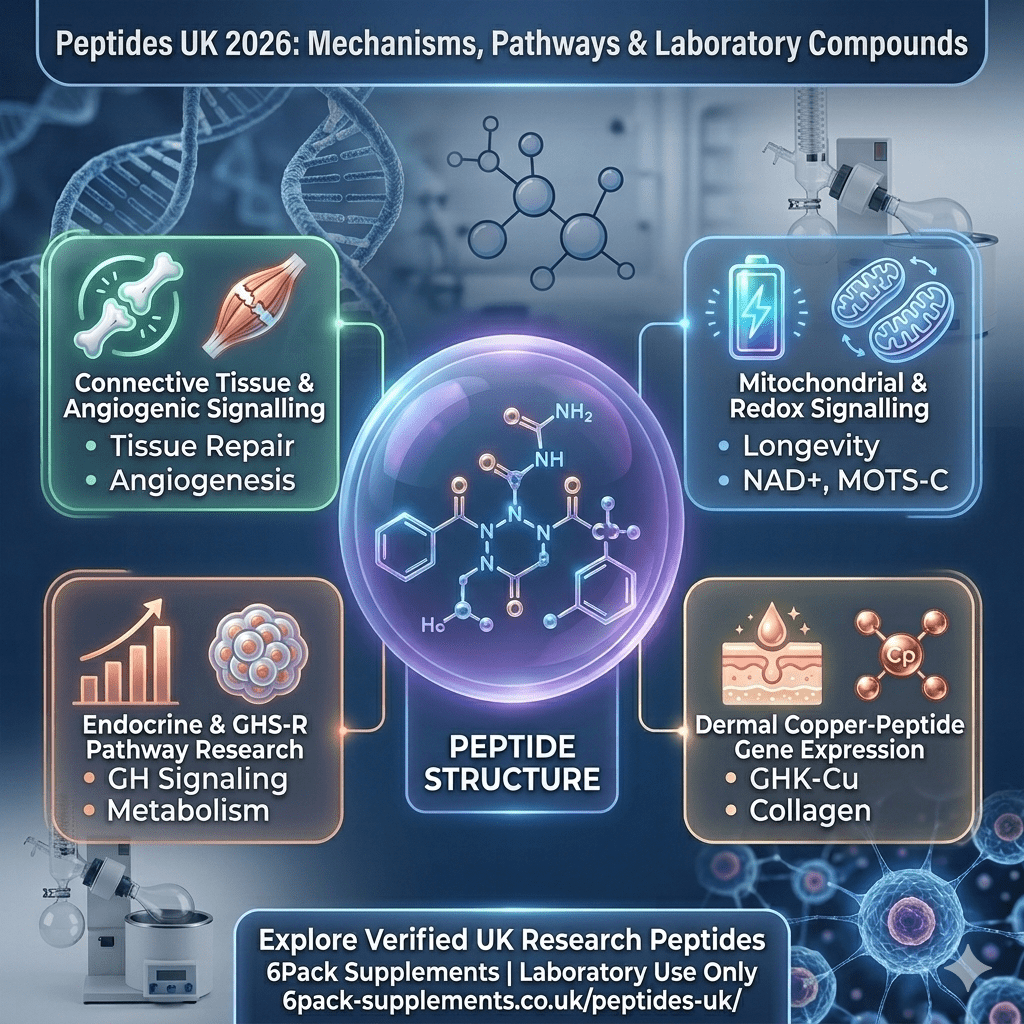
Primary signalling categories include:
• Angiogenic and connective tissue modulation
• GHS-R mediated endocrine interaction
• Mitochondrial and redox pathway signalling
• Extracellular matrix and copper-binding gene expression
Connective Tissue & Angiogenic Signalling Research
One of the most active domains in UK laboratories involves fibroblast activity, nitric oxide regulation and angiogenesis-associated pathway modelling.
Research frameworks typically analyse:
• VEGF interaction
• Collagen deposition dynamics
• Cellular migration signalling
• Nitric oxide cascade modulation
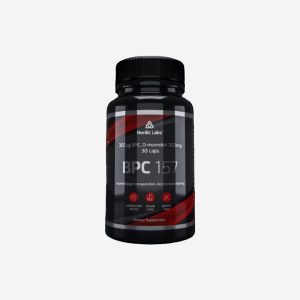
Within these models, compounds such as BPC-157 (laboratory grade) are frequently referenced in connective tissue pathway studies:
https://6pack-supplements.co.uk/product/bpc157-10mg-peptide/
Combination frameworks are also explored, including paired signalling models such as BPC157 + TB500 research stacks:
https://6pack-supplements.co.uk/product/bpc157-tb500-5-5mg-stack-nordic/
Structural copper-associated matrix research often references blends containing GHK-Cu within dermal-associated signalling environments.
Dermal Copper-Peptide Gene Expression Pathways
Tripeptides with metal-binding properties are investigated for their interaction with extracellular matrix signalling and collagen transcription mechanisms.
Laboratory interest focuses on:
• Copper chelation kinetics
• Collagen type I and III gene expression
• Fibroblast communication signalling
A representative compound within copper-associated pathway research is GHK-Cu (laboratory grade):
https://6pack-supplements.co.uk/product/ghk-cu-copper-peptide-50mg/
Such models remain confined to structural and biochemical analysis.
Endocrine & GHS-R Pathway Research
A major vector in UK peptide research involves interaction with the growth hormone secretagogue receptor (GHS-R1a).
Rather than external hormone models, research increasingly evaluates receptor-mediated pulse amplification and downstream IGF-1 cascade observation.
Investigative areas include:
• Endogenous GH pulse modelling
• IGF-1 signalling cascade response
• Lipolytic pathway signalling
• Metabolic flexibility frameworks
Compounds frequently referenced in UK endocrine signalling studies include:
Ipamorelin
https://6pack-supplements.co.uk/product/ipamorelin-5mg-peptide/
GHRP-6
https://6pack-supplements.co.uk/product/ghrp-6-10mg-peptide-nordic-labs/
GHRP-2
https://6pack-supplements.co.uk/product/ghrp-2-peptide-5-mg-nordic-labs/
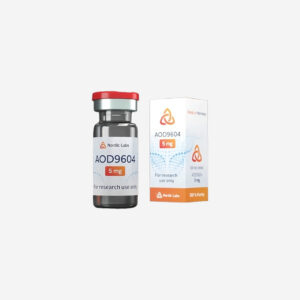
AOD9604, commonly explored in metabolic pathway investigations:
https://6pack-supplements.co.uk/product/aod9604-peptide-5mg-nordic/
These compounds are studied for signalling behaviour — not as licensed hormone treatments.
Mitochondrial & Redox Signalling Research
Longevity terminology in 2026 has shifted toward “healthspan-associated pathway analysis”.
UK laboratories investigating mitochondrial frameworks examine:
• NAD+ dependent redox reactions
• Oxidative stress signalling
• DNA repair pathway modulation
• Substrate utilisation cascades
High-interest laboratory compounds in this area include:
MOTS-C
https://6pack-supplements.co.uk/product/mots-c-40mg-peptide-nordic-labs/
NAD+ (laboratory compound)
https://6pack-supplements.co.uk/product/nad-500mg-peptide-nordic-labs-uk/
These research frameworks remain experimental and mechanistic.
Neuro-Associated & Melanocortin Signalling Research
Cognitive-pathway peptides and melanocortin receptor modulators also generate UK laboratory interest.
Neuro-related research reference:
Selank
https://6pack-supplements.co.uk/product/selank-10mg-peptide/
Melanocortin pathway investigations frequently reference:
Melanotan 2
https://6pack-supplements.co.uk/product/melanotan-2-peptide-10-mg-nordic/
and
Melanotan 2 Nasal
https://6pack-supplements.co.uk/product/melanotan-2-nasal-spray-10mg/
These remain receptor-specific research models only.
Laboratory Preparation & Structural Integrity
Peptide stability and reconstitution protocols form part of laboratory handling standards.
Supportive materials include bacteriostatic diluents such as:
https://6pack-supplements.co.uk/product/bacteriostatic-water-10-ml-nordic/
UK Peptide Research 2026: Quality & Regulatory Environment
Within the United Kingdom, peptides supplied via specialist retailers are listed strictly for laboratory research and analytical evaluation.
Quality indicators increasingly prioritised include:
• HPLC purity verification
• Batch-specific certification
• Lyophilized structural stability
• Controlled storage and transit conditions
Regulatory oversight increasingly focuses on misrepresentation and improper labelling rather than structured in-vitro supply chains.
Research Limitations & Context
It is essential to acknowledge:
• Many peptide models remain pre-clinical
• In-vitro behaviour may not translate in vivo directly
• Long-term human data may be limited or absent
• Biological response variability is significant
This distinction separates structured laboratory analysis from consumer-driven interpretation.
All compounds referenced are discussed strictly within the laboratory and biochemical research context.
Peptides Frequently Searched in the UK (2026)
High-intent UK searches include:
BPC-157 UK
TB500 UK
GHK-Cu UK
Ipamorelin UK
GHRP-6 UK
NAD+ peptide UK
MOTS-C UK
Melanotan 2 UK
For full UK research listings:
https://6pack-supplements.co.uk/product-category/peptides-uk/
Final Perspective
Peptide research in 2026 is defined by receptor specificity, signalling precision and pathway-focused biological modelling.
The value of peptides lies not in broad promise but in defined biochemical interaction.
For structured compound summaries and pathway-specific indexing, explore the full research hub:
https://6pack-supplements.co.uk/peptides-uk/